
Here is the honest, dermatologist-backed answer to how to get rid of acne scars: depressed (atrophic) scars cannot be erased with creams alone, but the right in-clinic treatments can improve them by 50–70%, sometimes more with combination treatment. Flat dark marks left after acne (post-inflammatory hyperpigmentation) can fade with creams and laser, but depressed scars need procedures that rebuild collagen or release scar tissue.
This guide explains each scar type, the treatments that work, realistic timelines, and how to prevent new scars. It is written by Dr. Pang, a board-certified dermatologist who treats acne and scarring in Asian skin every day. For a full treatment overview, see our Acne & Scar treatment page.
Can You Really Get Rid of Acne Scars? (The Quick Answer)
Yes — but the word “scar” covers several different problems, and each needs a different treatment. Matching the treatment to the scar is the single biggest factor in your results. Here is the short version:
- Dark marks (PIH/PIE): Flat brown or red spots are not true scars. They fade over months and respond well to sunscreen, prescription creams, chemical peels, and pigment lasers.
- Depressed (atrophic) scars: Ice pick, boxcar, and rolling scars do not go away on their own. They need procedures that build collagen or release scar tissue, such as RF microneedling, subcision, and TCA CROSS.
- Raised (hypertrophic/keloid) scars: Less common on the face. These usually need steroid injections into the scar.
- Realistic expectation: The goal is major improvement, not perfection. Most patients see 50–70% improvement, sometimes more with combination treatment.
First, Know Your Acne Scar Type
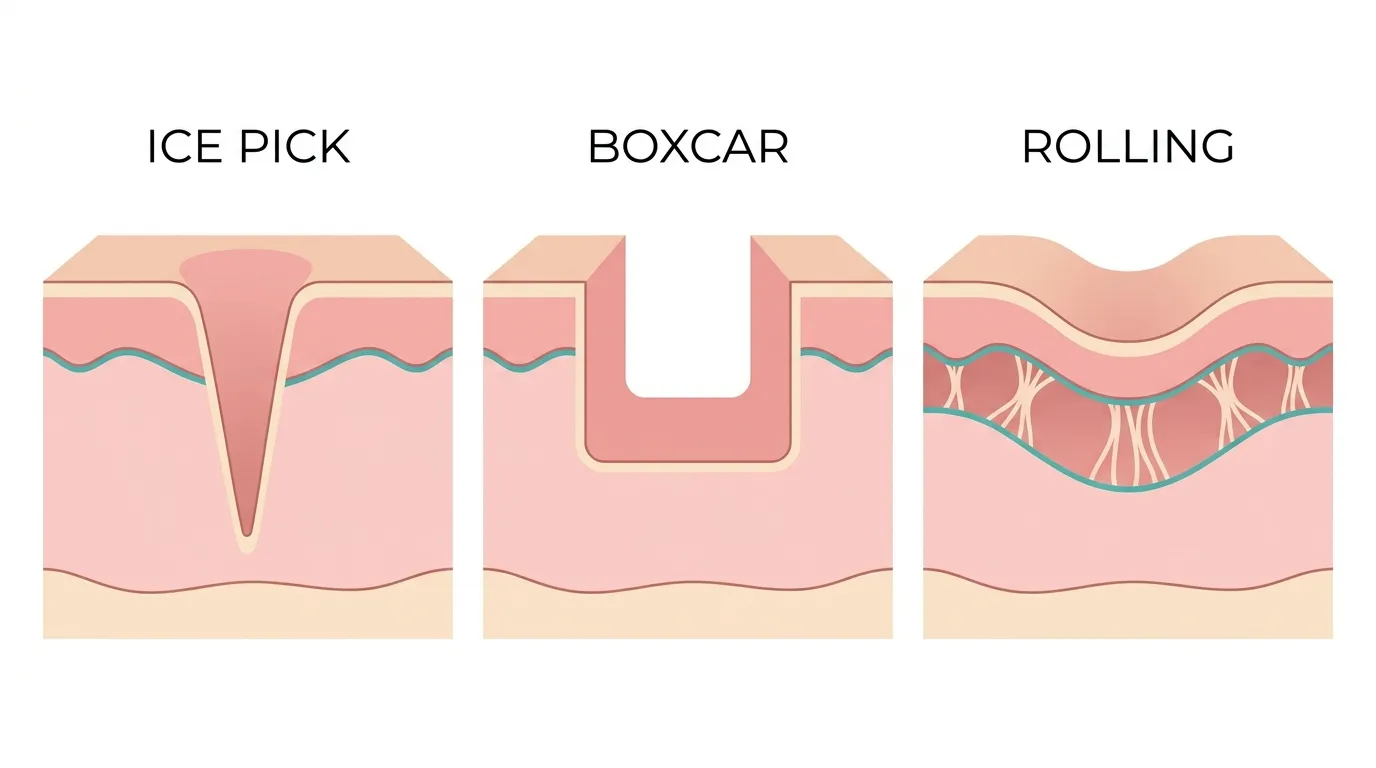
Knowing your scar type is the first step to effective treatment. Using one “scar treatment” for every scar is why many people end up disappointed with results. Most people have a mix of scar types, which is why a tailored plan combining treatments works best. The three main types of depressed acne scars are shown below.
| Scar Type | What It Looks Like | Best-Matched Treatments |
|---|---|---|
| Ice Pick | Deep, narrow, V-shaped pits | TCA CROSS |
| Boxcar | Wide depressions with sharp, defined edges | RF microneedling, subcision |
| Rolling | Broad, shallow, wave-like dips | Subcision, RF microneedling, dermal filler |
| PIH / Dark Marks | Flat brown spots (no texture change) | Topicals, chemical peels, Pico laser |
| PIE / Red Marks | Flat pink-red marks (no texture change) | Vascular laser, time, sun protection |
Acne Scars vs. Dark Marks: Why the Difference Matters
This is where most people get confused. Post-inflammatory hyperpigmentation (PIH) and post-inflammatory erythema (PIE) are colour changes, not texture changes. Run your finger over the area. If the skin feels smooth and flat, it is a mark, not a scar. Marks are much easier to treat and often fade on their own with good sun protection.
True scars are a physical change in the skin’s structure: collagen is either lost (creating a dip) or overproduced (creating a raised scar). These need procedures, not just products. If your main concern is stubborn brown patches rather than texture, our pigmentation treatment options may be a better starting point.
How to Get Rid of Acne Scars: The Treatment Options That Work
These are the proven procedures we use for acne scar revision. The best results come from combining two or three of them in one plan, because most faces show a mix of scar types.
One point worth stating plainly: our protocol favours treatments that rebuild collagen under the skin surface instead of stripping the surface away. On Asian skin, aggressive resurfacing carries a much higher risk of causing new pigmentation — and trading a texture problem for a pigment problem is a bad deal. The treatments below were chosen for that reason.
1. RF Microneedling: The Asian-Skin Workhorse
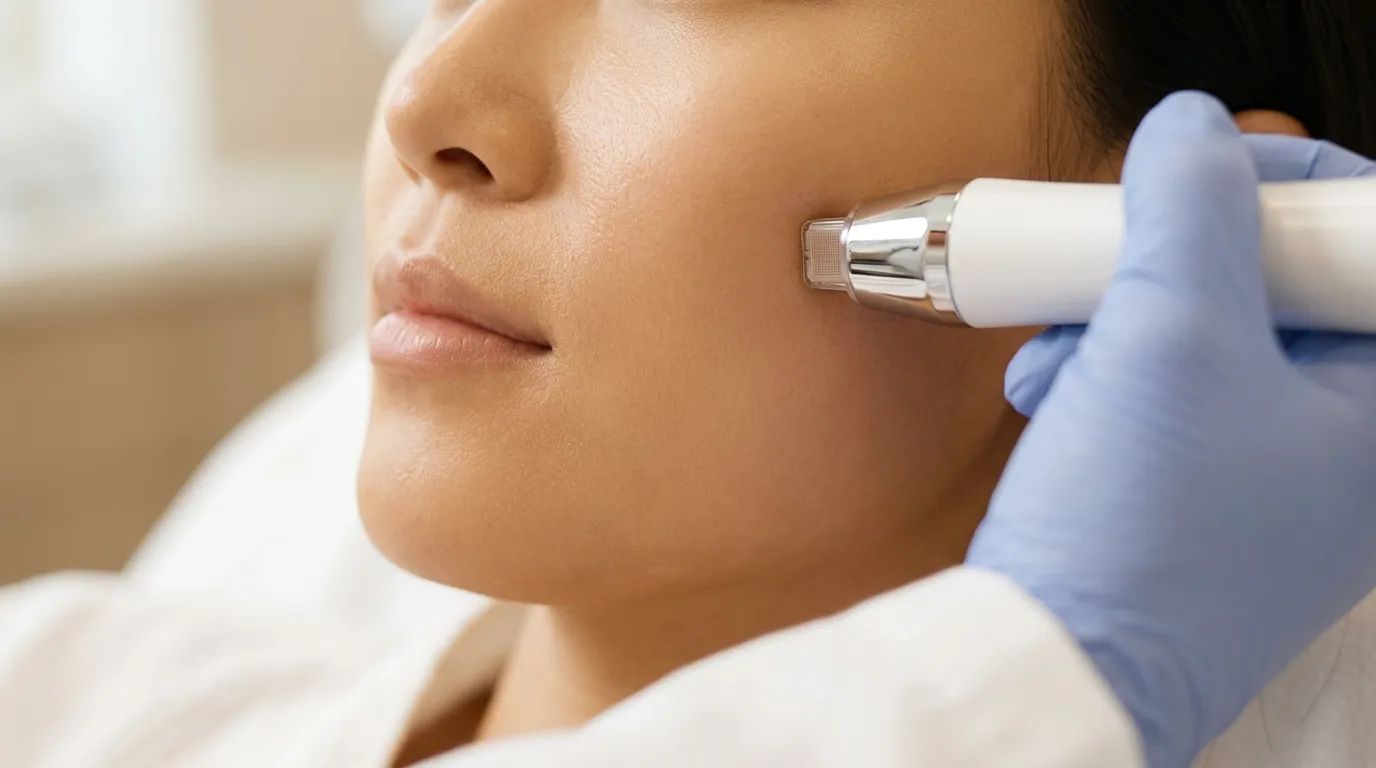
Radiofrequency (RF) microneedling is the cornerstone of modern scar revision, especially for darker skin tones. Fine insulated needles deliver heat directly into the dermis, triggering collagen and elastin rebuilding at the exact depth of the scar while leaving the skin’s surface mostly untouched. This is what makes it much safer than surface-removing lasers on Asian skin, where heat can trigger new pigmentation. It works well for boxcar and rolling scars and overall texture, and most of our scar plans are built around it. Learn more about the Exion RF microneedling platform we use.
2. TCA CROSS: For Deep Ice Pick Scars
TCA CROSS (Chemical Reconstruction of Skin Scars) treats each ice pick scar one by one. A high concentration of trichloroacetic acid is placed into the base of each narrow pit, triggering controlled healing that fills it from the bottom up. It reaches scars that needling devices cannot, because ice pick tracts are narrower and deeper than any needle array can treat. It is applied point by point and is usually combined with other treatments across a course.
3. Subcision (and Fillers): For Tethered Rolling Scars
Rolling scars are pulled down by fibrous bands that tether the skin to deeper tissue. No surface treatment can lift a scar that is anchored from below. Subcision uses a fine needle or cannula to release these bands so the skin can lift. The released space can then be supported with collagen-stimulating treatments or, in selected cases, dermal filler for an immediate lift. See our dermal filler and injectables options for how this is used in scar correction.
4. Punch Excision and Punch Elevation: For Selected Deep Scars
A small number of very deep ice pick or boxcar scars respond best to minor surgical correction. Punch excision removes the entire scar with a small circular blade, and the tiny wound is closed with a fine stitch, leaving a small line that fades over the following months. Punch elevation cuts the scar free at its base and lifts it level with the surrounding skin — nothing is removed, so your own skin colour and texture are preserved. Both are quick procedures done under local anaesthetic, best suited to a few deep scars with healthy skin between them, and they are usually reserved for scars too deep for TCA CROSS or microneedling. RF microneedling is often used afterwards to blend the treated edges into the surrounding skin.
5. Medical Chemical Peels: For Surface Texture and Marks
Medical-grade peels use AHA, BHA, or TCA at controlled strengths to speed up cell turnover, unclog pores, and smooth shallow surface unevenness. They cannot rebuild a deep scar on their own, but they earn a clear place in a combination plan: they keep active acne under control, fade post-acne dark marks, and improve how evenly the skin reflects light — a big part of why scarred skin looks scarred. Strength and contact time are adjustable, so peels can start gentle on Asian skin and build up gradually instead of being pushed hard in one session.
6. Pico Laser: For Dark Marks and Pigment
For PIH and post-acne dark marks, Pico laser fires ultra-short pulses that shatter excess pigment into tiny particles the body clears on its own. Because the pulses last picoseconds, very little heat spreads into nearby skin — which matters on Asian skin, where heat itself can trigger fresh pigmentation. Pico laser fixes colour, not texture, so it suits flat marks rather than pits. If your marks are pink or red rather than brown, that is PIE, and a vascular laser that targets the dilated blood vessels is the better match.
7. Skin Boosters for Overall Skin Quality
Once scars are corrected, hydrating and bio-remodelling injectables improve smoothness, elasticity, and glow, helping treated areas blend with the surrounding skin. Options such as skin boosters, skin mesotherapy, and Profhilo bio-remodelling are common finishing and maintenance steps.
Which Treatment Is Right for Your Scars?
Use this quick guide as a starting point. A consultation is still essential, because scar depth, skin tone, and the mix of scar types all change the plan.
| Your Main Concern | First-Line Approach | Often Combined With |
|---|---|---|
| Deep narrow pits (ice pick) | TCA CROSS | RF microneedling |
| Sharp-edged craters (boxcar) | RF microneedling | Subcision, medical peels |
| Wavy tethered dips (rolling) | Subcision | RF microneedling, filler |
| Flat brown spots (PIH) | Topicals + sun protection | Pico laser, peels |
| Flat red marks (PIE) | Sun protection + time | Vascular laser |
| Mixed scarring (most people) | Combination protocol | Maintenance skin boosters |
At-Home vs. Professional Treatment: What Actually Works
Home care has a real but limited role. It works well for fading marks and improving skin quality, and it supports the skin before and after procedures — but it cannot rebuild lost collagen in a deep scar. Here is an honest breakdown:
- Worth doing at home: daily broad-spectrum SPF 30–50, a prescription or cosmeceutical retinoid, vitamin C, azelaic acid, and gentle exfoliating acids for marks and texture.
- Manage expectations: over-the-counter “scar creams” and silicone gels help raised scars more than depressed ones.
- Avoid: at-home dermarollers and aggressive DIY peels on acne-prone skin. They risk infection, irritation, and new pigmentation.
- Leave to professionals: TCA CROSS, subcision, medical-depth peels, Pico laser, and RF microneedling.
The Two-Phase Strategy: Control, Then Repair
Here is the principle most people miss: you cannot treat scars effectively while acne is still active. Working on inflamed, breaking-out skin is ineffective and can create new damage. That is why we follow a two-phase protocol.
- Phase 1, Control (Months 1–3): Clear and calm active acne with medical facials, chemical peels, LED therapy, and prescription topical or oral treatment. The goal is no new breakouts.
- Phase 2, Repair (Month 3 onward): With acne controlled, treat existing scars and dark marks with the procedures matched to each scar type, then keep results with skin-quality treatments.
How to Prevent Acne Scars in the First Place
Prevention is always easier than correction, and most scarring can be prevented with early, proper acne treatment. Build these habits, and see our full guide on how to prevent acne scars for more detail.
- Treat acne early and properly. The longer inflammation lasts, the higher the scar risk. See a dermatologist for moderate or persistent acne instead of waiting it out.
- Never pick or squeeze. Picking pushes inflammation deeper and is a leading cause of both pitted scars and dark marks.
- Wear sunscreen daily. UV makes post-acne marks darker and last longer. Broad-spectrum SPF is non-negotiable.
- Be consistent. Stick to your prescribed routine. Stopping lets acne — and scarring — come back.
What Results Can You Realistically Expect?
Scar revision is a process, not a single appointment. Collagen keeps rebuilding for months after each session, so improvement is gradual and builds over time. This table is a realistic guide — your dermatologist will adjust it to your scar severity and skin type.
| Timeframe | What to Expect |
|---|---|
| After 1 session | Mild smoothing; skin may look slightly pink or feel rough as it heals |
| 3–6 months (3–4 sessions) | Visible texture improvement as new collagen forms |
| 6–12 months | Peak results; depressed scars noticeably shallower, tone more even |
| Ongoing | Maintenance and skin-quality treatments keep and refine results |
Frequently Asked Questions
Can acne scars go away naturally?
Flat dark or red marks (PIH and PIE) often fade on their own within 3–24 months, especially with good sun protection. True depressed scars (ice pick, boxcar, rolling) do not. They are a permanent change in skin structure and need professional treatment to improve.
How many treatments will I need?
Most patients need 3–6 sessions, spaced about 4–6 weeks apart, depending on scar type and severity. Deeper, mixed scarring usually needs more sessions and a combination of techniques.
Are acne scar treatments safe for dark or Asian skin?
Yes, when an experienced dermatologist chooses the right technique and settings. Asian skin has a higher risk of pigmentation after treatment, which is why we build plans around surface-sparing options like RF microneedling, subcision, and TCA CROSS instead of aggressive ablative resurfacing.
Is acne scar removal painful?
Most procedures use topical numbing cream, so discomfort is usually mild and manageable. Downtime ranges from one day of redness to about a week depending on the treatment.
What is the best treatment for acne scars?
There is no single “best” treatment — it depends on your scar type. For most people with mixed scarring on Asian skin, a combination plan built around RF microneedling, with TCA CROSS, subcision, medical peels, and pigment treatments added as needed, gives the most reliable improvement.
Ready to Treat Your Acne Scars?
Acne scars are highly treatable when the plan matches the scar and is built by a board-certified dermatologist who understands your skin type. The first step is finding out exactly which scar types you have. Explore our complete acne and scar treatment programme, or book a personalised skin assessment with Dr. Pang to plan your path to smoother, clearer skin.
References & Further Reading
- American Academy of Dermatology Association. Acne scars: Overview
- DermNet. Acne Scarring
- Cleveland Clinic. Acne Scars: Causes, Types & Treatment
- Fabbrocini G, et al. Acne Scars: Pathogenesis, Classification and Treatment (Dermatology Research and Practice)
- Connolly D, et al. Acne Scarring—Pathogenesis, Evaluation, and Treatment Options (JCAD)
This article is for educational purposes only and does not replace a personal medical consultation. Individual results vary.