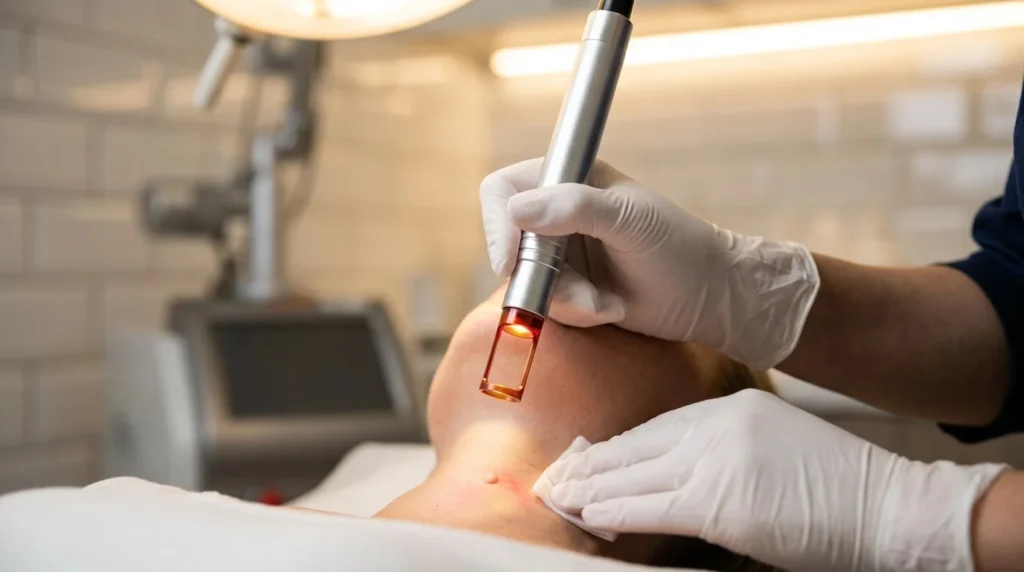
If you have decided to remove a stubborn skin tag, mole, cherry angioma, milia, sebaceous hyperplasia, cyst, or body wart, the question you should be asking is not “How fast?” — it is “How safe?” Because skin removal procedures are permanent, and the technology your dermatologist chooses will dictate whether you walk away with a clean, almost invisible result — or a noticeable scar, pigment change, or repeated regrowth.
Among every modality available today — scissor snipping, electrocautery, cryotherapy, radiofrequency, scalpel excision, and laser — the ablative CO2 laser has earned its place as the international gold standard for the surgical removal of benign skin lesions. In this article, our team at Dr. Pang Skin Clinic in Bangkok explains exactly why — the science behind the laser, what makes it inherently safer than alternatives, the lesions we treat (and the ones we don’t), and what you should expect from a properly performed CO2 laser procedure in 2026.
Why Safety Should Be Your First Question
Patients often shop for skin tag and mole removal the same way they shop for haircuts — comparing prices, asking how long it takes, looking at “before and after” photos. That is the wrong frame. Skin removal is a minor surgical procedure. Anything that breaches the skin barrier carries risks: bleeding, infection, scarring, pigment change (especially in Asian and South-East Asian skin), and incomplete removal that leads to regrowth. The right question is: which technique minimises every one of those risks at the same time?
That is the question ablative CO2 laser answers better than any other tool in dermatology. It is also why properly trained board-certified dermatologists — not beauty therapists, not pharmacy “tag-removal pens”, not over-the-counter freezing kits — should always be the people holding the device.
What Is Ablative CO2 Laser? (And Why It Is Not the Same as Fractional CO2)
The CO2 (Carbon Dioxide) laser is a surgical laser that emits a single, highly focused beam at the 10,600 nm wavelength. That specific wavelength is absorbed almost entirely by the water molecules inside skin cells — so when the laser passes over tissue, the water inside the cells instantly vaporises, and the cell along with it. The result is precise, layer-by-layer tissue removal with a beam controlled to the micron.
Important distinction: the term “CO2 laser” gets used loosely online, but there are actually two completely different procedures sharing the name.
- Fully ablative CO2 laser (laser cutting) — what we use at Dr. Pang Skin Clinic. The full energy of the laser is delivered to a tiny, defined target area to surgically vaporise a lesion. It is the gold standard for removing skin tags, moles, milia, cherry angiomas, sebaceous hyperplasia, cysts, and body warts.
- Fractional CO2 laser — a resurfacing treatment that breaks the beam into thousands of micro-columns spread across a large facial area to stimulate collagen for wrinkles and acne scars. We do not offer fractional CO2 resurfacing at Dr. Pang Skin Clinic. For acne scars and skin renewal we prefer RF microneedling and modern non-ablative protocols, which are safer and produce more consistent results on Asian skin.
So when this article talks about CO2 laser, we mean fully ablative, surgical-precision laser cutting — the same energy a scalpel would do, but delivered as light rather than steel.
Benign Skin Lesions We Remove with Ablative CO2 Laser
Dr. Pang Skin Clinic uses ablative CO2 laser to remove the following common, non-cancerous skin lesions. Every patient is dermatologist-assessed first — and where appropriate, examined under dermatoscopy — to confirm the lesion is benign and suitable for laser removal before any treatment is performed.

- Skin tags (acrochordons) — soft, pedunculated outgrowths most common on the neck, underarms, eyelids, groin, and under the breasts. CO2 laser removes them in seconds, usually in a single visit, with no sutures.
- Moles (benign nevi) — raised or flat pigmented spots. Every mole is examined dermatoscopically before removal. Any mole with suspicious features (irregular borders, multiple colours, recent change, asymmetry) is referred for surgical excision and pathology — never lasered.
- Milia — tiny white cysts trapped just beneath the surface, most often around the eyes and cheeks. CO2 laser creates a clean micro-opening so the keratin core can be lifted out, leaving the surface intact.
- Sebaceous hyperplasia — soft yellowish bumps with a small central dimple, often appearing on the forehead and cheeks of adults over 35. CO2 laser is regarded in the dermatology literature as one of the most effective single-session treatments for these lesions.
- Cherry angiomas — bright red dome-shaped spots formed by clusters of small blood vessels. Because the CO2 laser seals tiny vessels as it works, removal is virtually bloodless.
- Epidermoid & sebaceous cysts — small, slow-growing lumps under the skin. CO2 laser is used to make a precise mini-incision and remove both the cyst wall and contents, which lowers recurrence risk.
- Body warts (verruca vulgaris on the trunk and limbs) — viral lesions that respond well to ablative removal once dermatologist-diagnosed. Note: we do not treat plantar warts on the soles of the feet or warts on the hands, as these locations require different protocols and follow-up regimes.
For full transparency, here are conditions we are often asked about but do not treat at Dr. Pang Skin Clinic: syringoma (tiny benign sweat-duct tumours, most often under the eyes) and xanthelasma (yellowish cholesterol deposits on the eyelids). Both sit in highly delicate periorbital skin and we believe they are best managed by specialist oculoplastic or surgical referral rather than in-office laser. If you contact us about either, we will direct you to a trusted referral pathway.
Why Ablative CO2 Laser Is the Gold Standard for Safety
There are five intrinsic safety advantages that make ablative CO2 laser the preferred tool for benign lesion removal — and that no other single technology offers in combination.
1. Micron-Level Precision
The CO2 beam is focused down to a fraction of a millimetre, so the dermatologist can shave a lesion layer by layer until it sits flush with healthy surrounding skin — and stop the instant they reach normal tissue. A scalpel, by contrast, must cut below the lesion and through healthy dermis to remove it, which is why traditional excision always leaves a longer, more visible scar.
2. Built-In Cauterisation — Virtually Bloodless
The heat from the CO2 laser instantly seals tiny blood vessels and lymphatic channels as it cuts. Most skin tag, mole, and cherry angioma removals require no bleeding control at all. Less bleeding means a clearer surgical field, lower infection risk, and a cleaner final scar — all three of which are direct safety wins.
3. Lower Infection Risk
Because the laser is non-contact (no blade touches the wound bed) and because the thermal energy sterilises the wound margin in passing, CO2 laser sites carry a significantly lower clinical infection rate than scalpel excision or aggressive electrocautery. Combined with proper aftercare, post-treatment infection in a healthy patient is rare.
4. Minimal Scarring
Because no sutures are needed for most lesions and the surrounding dermis is preserved, the healed site usually fades into a small, soft, flat mark — often imperceptible at conversational distance after 4 to 8 weeks. Multiple peer-reviewed comparative studies confirm that ablative laser excision produces less visible scarring than scalpel excision for benign lesions of equivalent size.
5. Single-Session Efficiency
One visit, one local anaesthetic, multiple lesions treated at once. Compared with cryotherapy (which often needs 2–3 sessions) or pen-based devices (which often only address superficial tissue), CO2 laser typically completes the job in a single session — reducing the cumulative risk that comes with repeated procedures.
Ablative CO2 Laser vs Scalpel Excision: A Side-by-Side Comparison
| Feature | Ablative CO2 Laser | Scalpel Excision |
|---|---|---|
| Mechanism | 10,600 nm light vaporises tissue layer by layer | Blade cuts through skin, lesion lifted out as one piece |
| Bleeding | Minimal — vessels sealed in real time | Significant — requires haemostasis & pressure |
| Sutures required | Usually none | Yes — for any lesion >3 mm |
| Healing time | 7–14 days for most lesions | 2–6 weeks; sutures out at day 7–14 |
| Scarring | Small flat mark, usually fades within weeks | Linear scar permanent, length > lesion diameter |
| Pathology specimen | Not preserved (lesion vaporised) | Preserved — can be sent for histopathology |
| Best for | Confirmed benign lesions | Suspicious lesions, large cysts, deep moles |
This table captures the most important nuance in this entire article: CO2 laser is the gold standard for benign lesions. The moment there is even a hint of clinical suspicion — irregular borders, recent change, mixed pigment, family history of melanoma — the right answer shifts to scalpel excision plus histopathology, not laser. Knowing when to switch is part of why a board-certified dermatologist matters.
The Critical First Step — Dermatoscopy Before Anything Else
At Dr. Pang Skin Clinic, no lesion is lasered without first being examined under a dermatoscope — a specialised polarising magnifier that lets us see pigment networks, vessel patterns, and structural features that are invisible to the naked eye. This 60-second step is the single most important safety check in skin-lesion removal, because it filters out the very small number of pigmented lesions that look benign but are actually early-stage melanoma. Laser vaporises tissue and leaves nothing to send to the lab — so screening must happen before, not after.
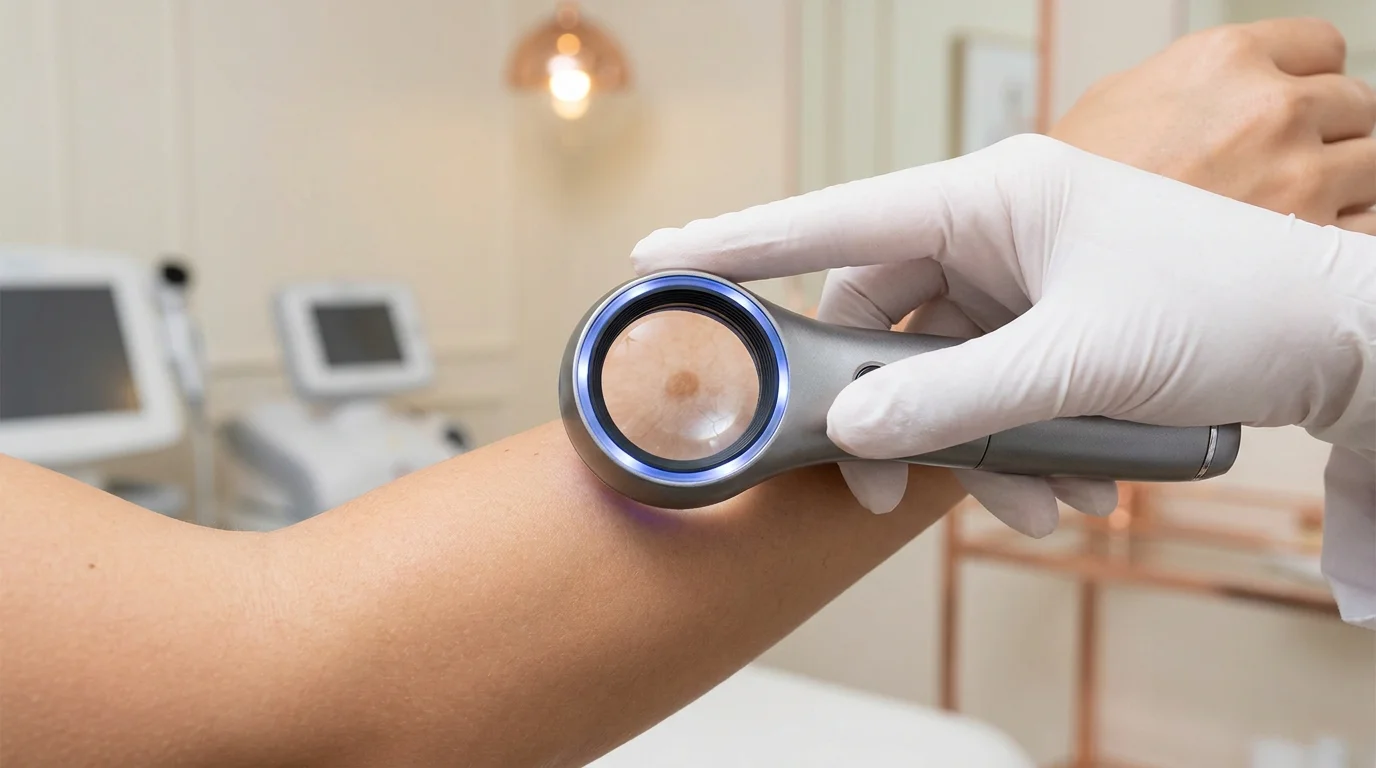
If anything looks atypical, we refer for surgical excision with histopathology. If everything looks clearly benign, we proceed with laser, confident the lesion is safe to treat.
What to Expect on the Day of Your Treatment
- Consultation & dermatoscopy. Dr. Chris or Dr. Bank examines each lesion, photographs it, and confirms suitability. You will be told exactly what is to be removed and what to expect.
- Topical numbing cream. Applied 20–30 minutes before treatment for sensitive areas like the face and eyelids.
- Local anaesthetic injection. A tiny amount of lidocaine is injected at each lesion. After this, you will feel nothing — only mild pressure.
- Laser removal. Each skin tag or small lesion takes around 10–30 seconds. A typical session of 5–10 lesions is completed in well under an hour.
- Wound dressing. Antibiotic ointment is applied to each site. Small dressings cover larger sites; no dressing is needed for most skin-tag removals.
- Aftercare instructions. Written and verbal, plus a follow-up line on LINE / WhatsApp for any concerns during healing.
Healing Timeline — What Your Skin Does Day-by-Day
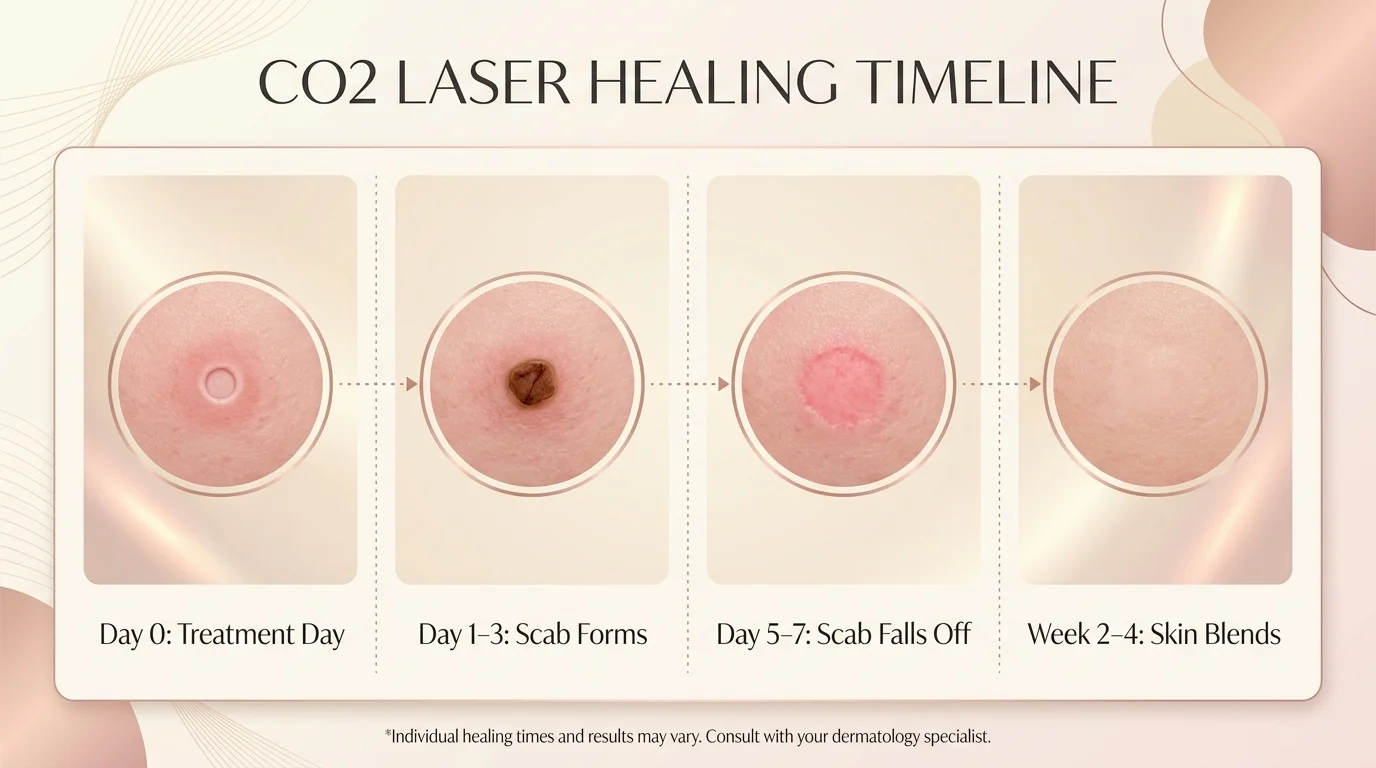
- Day 0 — Treatment Day. The treated site looks like a small pink dot or shallow well. Mild swelling and tenderness may be felt for a few hours.
- Day 1–3 — Scab Forms. A thin protective scab — usually the size of a sesame seed — forms over each site. This is the body’s natural dressing. Do not pick it.
- Day 5–7 — Scab Falls Off. The scab separates on its own to reveal fresh pink skin underneath. This is the most fragile phase — sun protection is critical here.
- Week 2–4 — Skin Blends. The pink fades to your natural skin tone over 2–4 weeks for most patients (longer on the trunk and shins). After this, most marks are barely visible.
Aftercare: The Patient’s Half of the Equation
The laser does its work in seconds, but the final cosmetic result is shaped over the following 4 weeks — and most of that is in your hands. Follow these aftercare rules to give your skin the smoothest possible outcome:
- Keep the area clean and dry for the first 24 hours. After that, gentle cleansing with mild soap is fine.
- Apply the prescribed ointment twice daily until the scab falls off naturally. Do not pick or pull the scab.
- Use SPF 50+ on the treated area every day for at least 3 months. Post-inflammatory hyperpigmentation is the most common avoidable complication on Asian skin — and it is almost entirely sun-driven.
- Avoid makeup directly over the site for the first 5–7 days.
- Skip the swimming pool, sauna, and high-intensity workouts for the first week.
- Contact the clinic if you notice spreading redness, pus, or increasing pain — these are uncommon but treatable if caught early.
Who Should Pause Before Booking
Ablative CO2 laser is one of the safest procedures in dermatology, but a few situations warrant a different approach or a delayed booking:
- Pregnant or breastfeeding patients — we usually defer purely cosmetic removal until after weaning.
- Active skin infection at the lesion site — treat the infection first.
- Recent isotretinoin use — usually requires a 4–6 month gap before any ablative procedure.
- History of keloid scarring — does not rule out treatment, but we plan with extra caution and follow-up.
- Suspicious-looking lesions — surgical excision plus pathology is the correct route, not laser.
Why Patients Choose Dr. Pang Skin Clinic in Bangkok
Skin lesion removal is, in technical terms, minor surgery — and the experience of the dermatologist matters more than the brand of the laser machine. Every procedure at Dr. Pang Skin Clinic is performed by a board-certified dermatologist in a sterile in-clinic minor surgery room, with dermatoscopic screening before treatment and structured aftercare follow-up afterwards.
- Dr. Sukit Chansuntinukul (Dr. Chris) — MSc in Dermatology, Ramathibodi Hospital, Mahidol University; specialised training in laser & cosmetic dermatology at the Greater Miami Skin and Laser Center, Florida, USA.
- Dr. Panod Chinpipat (Dr. Bank) — Board-Certified Dermatologist, Institute of Dermatology, Ministry of Public Health, Thailand; Fellowship in Procedural Dermatology & Lasers, Ramathibodi Hospital, Mahidol University.
For a full overview of our CO2 laser surgery service — pricing, photo gallery, and lesion-specific protocols — visit the CO2 Laser Surgery treatment page.
Planning to have several lesions treated at the same time? Our companion guide, CO2 Laser for Skin Tags, Moles, and Warts: One Session, Many Lesions, covers how many lesions realistically fit into a single visit, what actually limits the session, and how to care for many small wounds at once.
Frequently Asked Questions
Does CO2 laser removal hurt?
The procedure itself is essentially painless thanks to topical numbing cream plus a tiny local anaesthetic injection. Mild stinging may be felt for a few hours afterwards as the anaesthetic wears off — well-managed with over-the-counter paracetamol if needed.
Will the lesion grow back?
For skin tags, milia, cherry angiomas, and most benign moles — no. Once vaporised at the correct depth, those specific lesions do not return. Cysts and warts have higher baseline recurrence rates regardless of method; ablative CO2 laser is among the lowest-recurrence options when performed correctly.
How many lesions can be treated in one session?
For small lesions, 10 to 20+ in a single appointment is routine. The limiting factor is your comfort and the total surface area treated, not the laser.
Can I go back to work the next day?
Yes, for almost all patients. The treated sites look like tiny scabs the size of a sesame seed — easy to cover with a plaster if needed. There is no anaesthesia hangover and no activity restrictions beyond avoiding water immersion and direct sun.
Is CO2 laser safe for darker Asian skin tones?
Yes — when performed by an experienced dermatologist using appropriate settings, and combined with diligent post-treatment sun protection. The main avoidable risk is post-inflammatory hyperpigmentation, which is almost entirely sun-driven and prevented by SPF 50+ for 3 months.
Ready to Remove It Safely?
If you have been living with a skin tag on your neck, a mole that catches on jewellery, a stubborn cherry angioma, milia under your eyes, sebaceous bumps on your forehead, or a body wart you would like permanently gone — book a consultation. We will dermatoscope every lesion, talk you through the right approach (whether that is laser, surgical excision, or referral), and give you a clear plan with realistic expectations.
📍 Dr. Pang Skin Clinic — Bangkok. Visit drpangskin.com/contact or message us on WhatsApp to book your assessment.