
Short answer: yes — in most cases, a dermatologist can remove skin tags, benign moles, and warts in the same single appointment with a CO2 laser. The laser itself is rarely the limit. What matters is the numbing, how many wounds your skin can heal at once, and whether every lesion has first been checked as harmless. This guide explains how a multi-lesion session is planned, how many lesions fit in one visit, which lesions must never be lasered, and how to heal many small wounds as cleanly as one.
Most people do not come to a skin clinic with one bump. They come with a collection: a row of skin tags on the neck, two raised moles that catch the razor, a cluster of warts on the back of the hand, and a few spots they have been quietly ignoring for years. The question they ask at reception is almost always the same — do I really have to come back four times for this?
Usually, no. This is the biggest practical advantage of CO2 laser surgery over methods that treat one lesion at a time: once the skin is numb, each small lesion takes only seconds. Adding lesion number twelve to your session costs far less time than lesion number one.

Why One Session Works: The Time Is in the Setup, Not the Laser
A CO2 laser emits light at 10,600 nm, a wavelength almost entirely absorbed by the water inside skin cells. The tissue is not cut — it turns to vapour, layer by layer, and the same heat seals the tiny blood vessels underneath. That is why removal is almost bloodless and why each lesion takes seconds, not minutes.
Break an appointment into its parts and the maths is simple. Checking, numbing, dressing, and instructions are fixed costs — you pay them once whether you remove two lesions or forty. Only the lasering itself grows with the number of lesions.
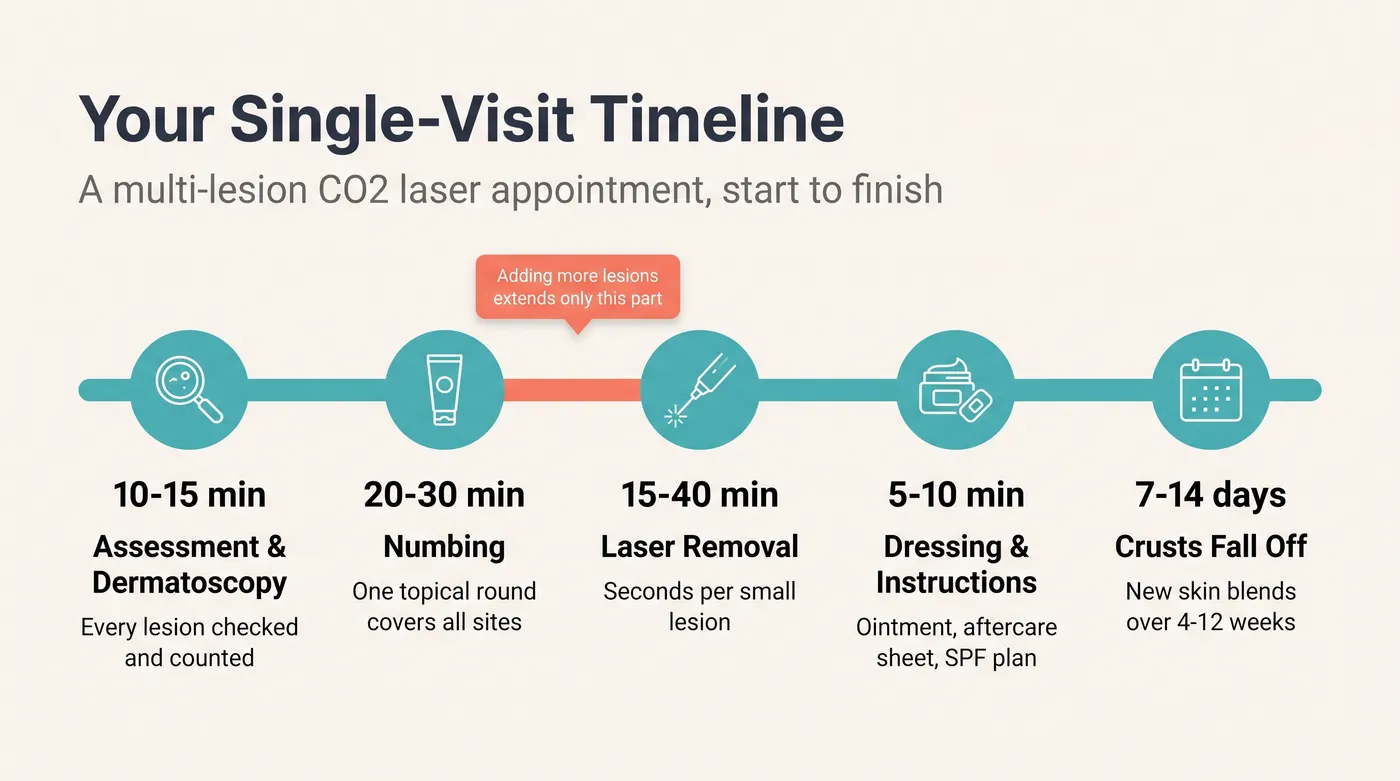
A patient having three lesions removed and a patient having thirty both sit through the same 20–30 minutes of numbing cream. The real difference between their visits is often just 20–25 minutes of lasering. Booking four separate visits means paying that fixed cost four times over — and going through four separate healing cycles instead of one.
Where Multiple Lesions Tend to Cluster
Benign lesions are not spread randomly. They follow friction, sun exposure, oil glands, and — for warts — where the virus has spread. Knowing the pattern lets your dermatologist plan one efficient session instead of chasing spots one by one.
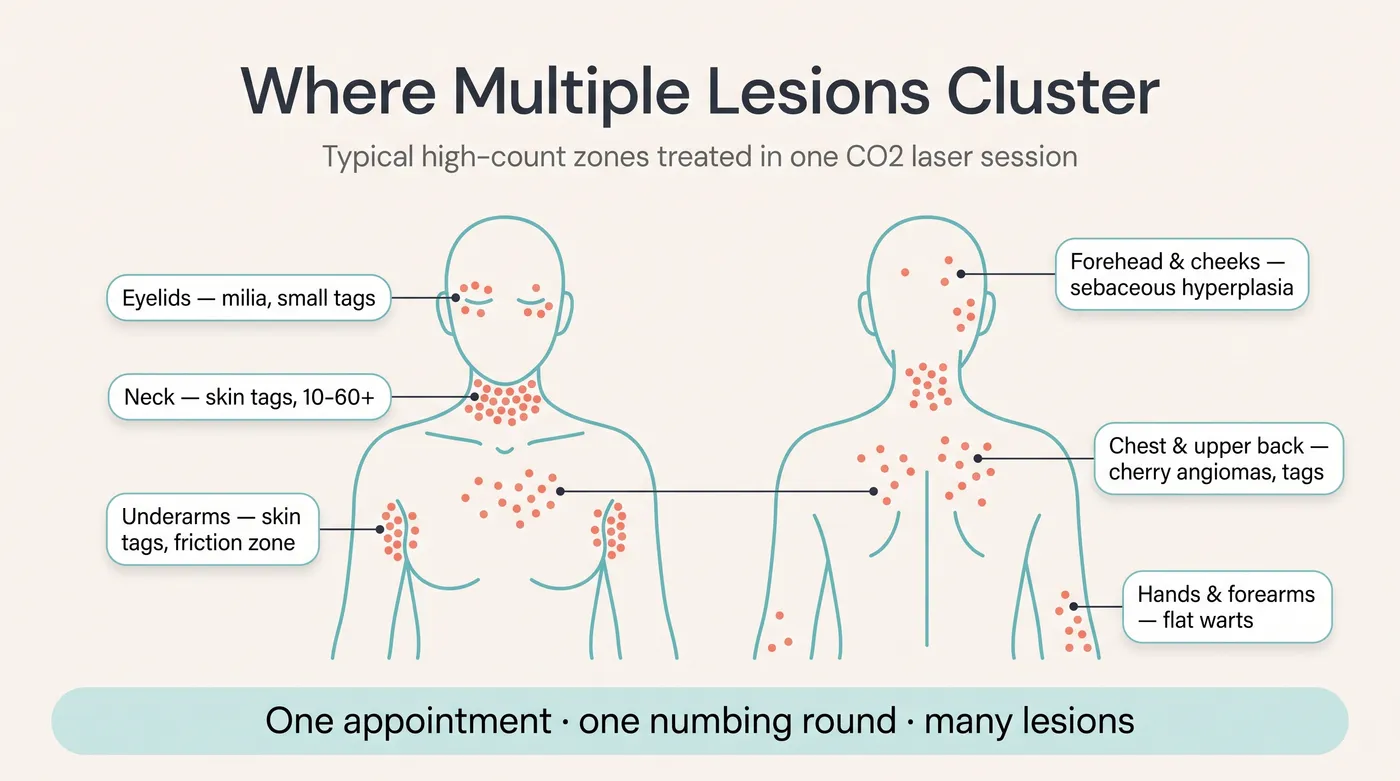
- Neck, underarms, under the bra line, groin — skin tags, caused by skin rubbing on skin. Finding 20–60 tags in these areas is routine. About half of adults get at least one skin tag in their lifetime, and having many is linked to insulin resistance, obesity, and metabolic syndrome — so a high count is worth mentioning to your doctor.
- Face, neck, trunk, and limbs — benign moles. Usually only a few are treated per session, because each one must be checked with a dermatoscope first.
- Hands, forearms, face, and trunk — viral warts, caused by the human papillomavirus (HPV). Flat warts spread in clusters, often carried by shaving or scratching.
- Eyelids and cheeks — milia. These hard little white bumps cannot be squeezed out like blackheads; the laser opens each one cleanly.
- Forehead and cheeks in adults — sebaceous hyperplasia: small yellowish bumps with a dent in the middle, caused by enlarged oil glands.
- Chest, trunk, and upper back — cherry angiomas: tiny bright-red spots made of small blood vessels. They vaporise cleanly with almost no bleeding.
Same Laser, Three Different Jobs
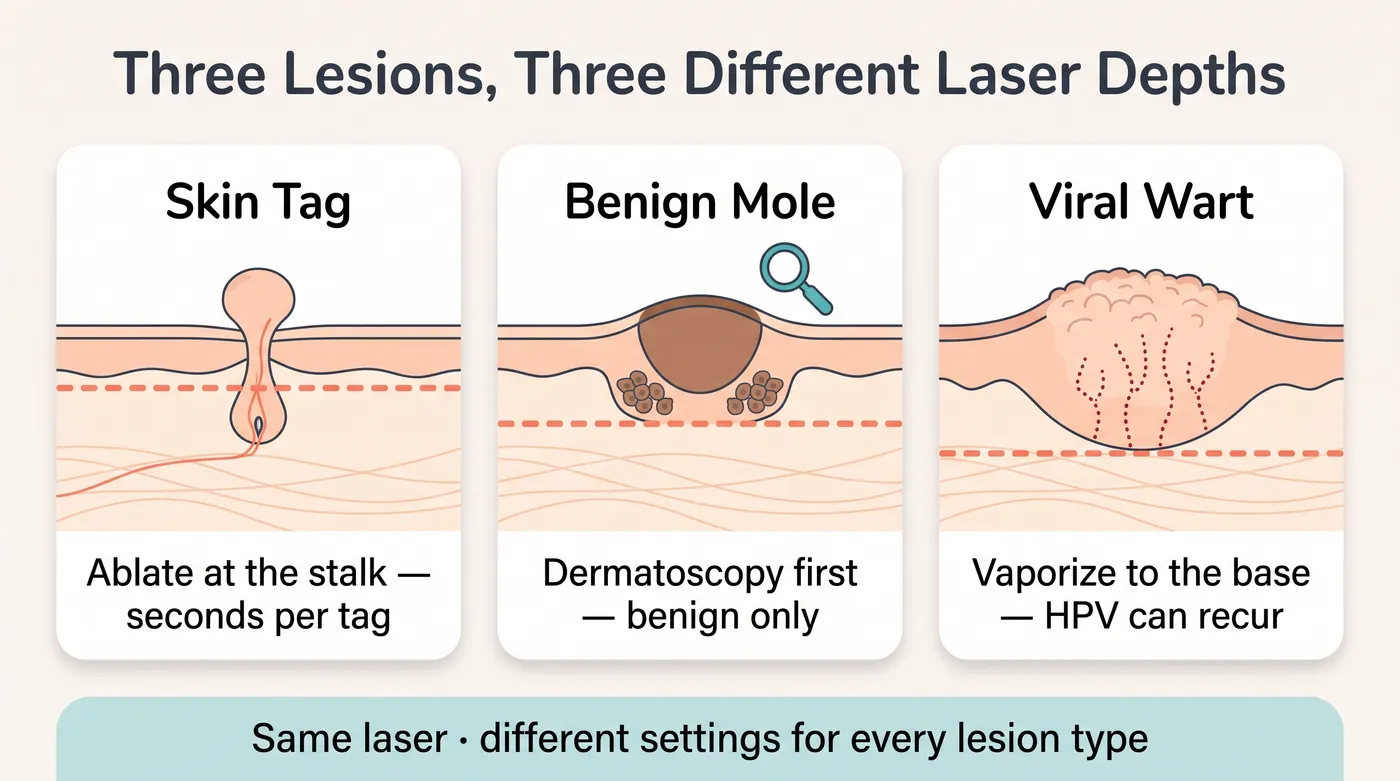
Skin tags, moles, and warts can share one appointment, but they are not treated the same way. Each is built differently, sits at a different depth, and carries a different risk. Your dermatologist adjusts the laser settings — spot size, energy, pulse mode, and number of passes — for each type, and sometimes for each individual lesion.
| Factor | Skin Tags | Benign Moles | Viral Warts |
|---|---|---|---|
| What it is | A soft flap of tissue on a narrow stalk | Clusters of pigment-making cells | Thickened skin infected by HPV |
| How deep the laser goes | Very shallow — across the base of the stalk | Deeper — down to the base of the pigment | Down to the base of the thickened tissue |
| Check before treatment | Simple visual check | Dermatoscope on every single lesion | Confirm it is a wart, not a corn or callus |
| Time per lesion | A few seconds | 1–3 minutes | 1–5 minutes, depending on thickness |
| Numbing | Cream is usually enough | Cream, plus an injection for larger moles | Injection is common for thick warts |
| Chance it comes back | Very low at the treated spot; new tags can appear elsewhere | Low if fully removed; can regrow if any is left behind | Real — HPV stays in nearby skin; a second treatment is sometimes needed |
| Typical number per session | 20–100+ | 1–5 | 5–20 |
One point deserves emphasis, because it is the most misunderstood part of the procedure. A wart is an infection, not just a growth. The laser vaporises the visible wart, but HPV can survive in normal-looking skin around it. Published studies of CO2 laser treatment for stubborn warts show that most patients clear, but in one published series around four in ten needed a second round within a few months. Anyone promising a guaranteed, permanent one-and-done cure for warts is overselling. If warts keep returning in crops, the real issue is the immune system, not the technique — and that belongs in a broader medical skin assessment.
How Many Lesions Can Realistically Be Removed in One Visit?
There is no fixed legal or technical limit. The real ceiling comes from four things, and a good dermatologist is watching all four while working.
- Numbing limits. Numbing cream has a maximum safe area, and injected numbing medicine has a maximum safe dose — the standard dermatologic surgery guideline is up to about 7 mg/kg of lidocaine with epinephrine. For a 60 kg adult that allows plenty of small-lesion work, but it is a real number. It is the reason a session covering large thick warts across both hands and feet may be split.
- Total wound load. Forty tiny tag spots on the neck heal easily. Forty deep wart wounds on one hand do not. What counts is the combined area and depth treated, not the number of lesions.
- Body area. Eyelids, lips, and skin over joints need gentler settings and more healing room. Crowding too many wounds into a delicate or constantly moving area raises the risk of a visible mark.
- Your downtime. Every treated spot crusts for 7–14 days. If your wedding is in ten days, treating your whole face in one sitting is possible — and unwise.
Within those limits, one session at our Bangkok clinic commonly covers a full neckline of skin tags together with two or three cleared moles and a cluster of hand warts — the exact collection most patients walk in with.
The Rule That Overrides Everything: Some Lesions Must Never Be Lasered
An ablative laser destroys the tissue it removes. That is the point — and the danger. Vaporised tissue cannot be sent to a laboratory. If a pigmented spot is lasered and later turns out to have been an early melanoma, the diagnosis is delayed and the original tissue is gone forever. In published reports of melanoma found in previously lasered lesions, the large majority were never examined under a microscope before treatment.
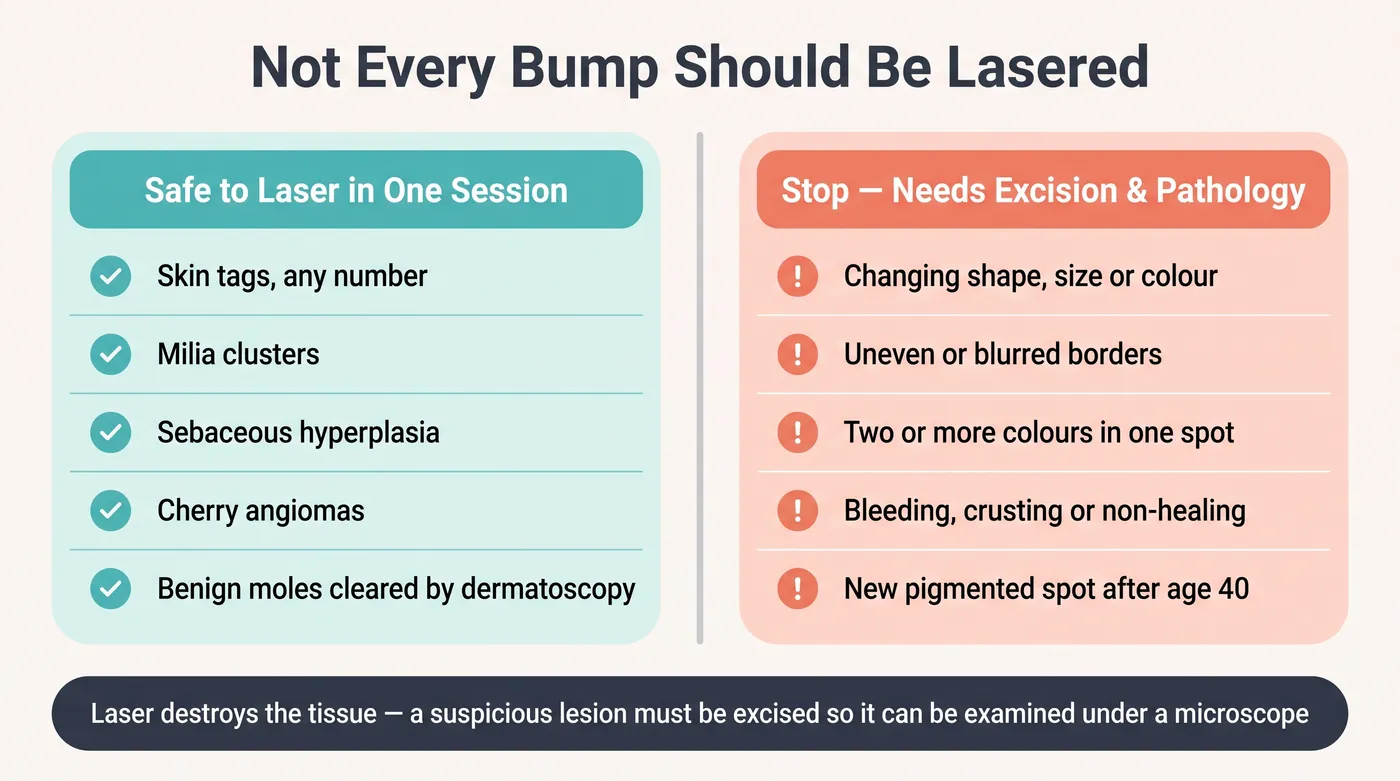
This is why every mole in a multi-lesion session is examined with a dermatoscope before the laser is switched on, and why a suspicious lesion is pulled off the day’s list and sent for surgical removal with laboratory testing instead. If a lesion shows warning signs, the correct next step is a skin cancer assessment, not a faster cosmetic fix. Dropping one lesion from the day’s list costs you almost nothing. Missing a melanoma costs everything.
The same logic rules out at-home devices, beauty-salon “mole pens”, and burning by non-physicians. Nobody in those settings uses a dermatoscope, and nobody there is in a position to say no.
What a Single Session Actually Costs You
In Bangkok, lesion removal is normally priced per lesion, often with tiers by size and type, and sometimes a bundle rate once the count passes a threshold. Because the consultation and preparation are charged once, combining lesions is almost always cheaper per lesion than making repeated visits. Rather than quoting a number that changes with lesion type, size, and count, we price only after Dr. Pang has actually seen and counted what you want treated — you get a written quote before anything is switched on.
The cost that is not about money matters just as much:
| Cost | One combined session | Four separate visits |
|---|---|---|
| Clinic time | About 60–90 minutes in total | About 45–60 minutes, four times over |
| Numbing rounds | 1 | 4 |
| Healing cycles | 1 crust phase of 7–14 days | 4 crust phases, possibly stretching across two months |
| Sun protection needed | One 12-week window | Four overlapping windows |
| Consultation fees | Charged once | Possibly charged at every visit |
Aftercare When You Have Twenty Wounds Instead of One
Looking after many wounds is not harder than looking after one — it is simply less forgiving, because one lapse affects every site at once. This is the routine we send patients home with:
- Days 1–7: apply the antibiotic ointment we give you to every treated spot, 2–3 times a day. Work from top to bottom so you do not miss any when there are dozens.
- Do not pick any crust. With many sites the temptation grows — and picking is the most common cause of a mark that outlasts the lesion it replaced.
- No swimming pools, saunas, or hot yoga until every spot has closed. Open wounds in shared water can get infected.
- Watch friction areas. Spots on the neck, underarms, and waistline rub against collars, straps, and seams. Loose clothing for the first week is wound care, not a preference.
- Weeks 2–12: once the crusts have fallen off on their own, switch to a plain moisturiser and broad-spectrum SPF 50+ every single day on every spot. Pause retinoids, AHAs, and BHAs on those areas for 4–6 weeks.
- Contact us early if any single spot becomes more painful, swollen, or starts weeping after day three — among twenty wounds, one infection is easy to miss.
Asian and Melanin-Rich Skin: Managing Pigment Risk Across Many Sites
Post-inflammatory hyperpigmentation (PIH) — a temporary brown mark that appears after a wound — is the complication that matters most for Fitzpatrick III–V skin, which describes most of our patients in Bangkok. In darker skin, pigment cells respond to inflammation by making more pigment, so any wound can leave a temporary brown mark. Reviews of full-face CO2 resurfacing report high PIH rates in darker skin types. Removing small individual lesions carries far less risk than resurfacing an entire face, but the same biology applies — and it applies at every treated spot at the same time.
Three things lower that risk:
- Gentle laser settings. Going only as deep as needed to clear the lesion — not deeper for speed — limits the inflammation that drives pigment.
- Strict sun protection. Broad-spectrum SPF 50+ daily for at least three months on healed spots is the best-proven way to prevent PIH in darker skin.
- Treat a mark early if it appears. PIH usually fades on its own over months. If it lingers, it responds well to targeted pigmentation treatment — it is a treatable nuisance, not a permanent scar.
When Two Sessions Are the Smarter Choice
Combining is the default, not a rule. We deliberately split treatment when:
- The plan involves many thick warts on the hands or feet, where numbing volume and wound depth both add up fast.
- Lesions sit on both eyelids, or on skin you need working normally for work in the coming week.
- You have a history of keloid or thick scars — we treat a small test area first and check the result before committing to the rest.
- You have active PIH, a recent sunburn, or an active skin infection in the treatment area. These are timing problems, not permanent barriers.
- You take isotretinoin, are immunosuppressed, or have poorly controlled diabetes — all of these change how wounds heal and need a tailored plan.
Frequently Asked Questions
Can skin tags, moles, and warts really be removed in the same appointment?
Yes. The same CO2 laser handles all three, with settings adjusted for each type. The conditions: every pigmented lesion must be checked as benign with a dermatoscope first, and the total wound load must stay within what is safe to heal in one go.
How many skin tags can be removed at once?
Skin tags are the easiest type — each spot is tiny and shallow. Sessions covering 20 to well over 100 tags across the neck, underarms, and trunk are routine, limited mainly by numbing coverage and how long you can sit still.
Does removing many lesions hurt more than removing one?
Not really. The whole area is numbed before any lasering starts, so you mostly feel pressure and warmth rather than pain. What grows with the count is mild stinging for a day or two afterwards, which the ointment we provide and simple painkillers handle easily.
Will the lesions come back?
A fully removed skin tag or benign mole does not grow back at the same spot. New skin tags can appear elsewhere, because the friction and metabolic causes remain. One caution for moles: if a lasered mole repigments, it must be excised and examined — not lasered again, because regrowth in a scar can look like melanoma under the microscope. Warts are the exception — HPV can stay in nearby skin, so a minority of patients need a second treatment.
Can I go back to work the next day?
For lesions on the body, almost always yes. For facial lesions, you will have small visible crusts for 7–14 days, which most patients manage comfortably. Avoid makeup on treated spots during the first week, so plan the timing around anything high-visibility.
Is CO2 laser removal safe on darker Asian skin?
Yes, when the settings suit your skin type and you protect the treated spots from the sun. The main consideration is temporary post-inflammatory hyperpigmentation — a brown mark that usually fades on its own.
Do I need a biopsy before laser removal?
Not for skin tags, milia, cherry angiomas, sebaceous hyperplasia, or warts. For pigmented lesions, dermatoscope examination is required, and any lesion with unusual features goes for surgical removal and laboratory testing instead of laser.
Planning Your Session at Dr. Pang Skin Clinic
Every CO2 laser session at our Bangkok clinic is performed by Dr. Pang, a board-certified dermatologist with over 13 years of clinical experience and more than 1,000 lesions removed. Every lesion is examined before treatment and priced before treatment — and anything that should not be lasered is said out loud, not quietly added to the list.
If you want the technical background on why ablative CO2 — rather than fractional CO2, pen devices, or freezing — is the international standard for benign lesion removal, our companion guide on why ablative CO2 laser is the gold standard for safety covers the science in depth. For treatment details and results, see the full CO2 laser surgery page.
Bring your whole list. Count them before you come if you can. Most people walk out of a single appointment finished with something they have been postponing for years — book a consultation and we will map the session properly.
Medical Disclaimer
This article is general education, not a substitute for an in-person skin examination. Treatment counts, timings, and results vary by individual. Any new, changing, bleeding, or non-healing skin lesion should be checked by a qualified doctor before any removal method is considered.
References and Further Reading
- Belgam Syed SY, Lipoff JB, Chatterjee K. Acrochordon (Skin Tag). StatPearls, NCBI Bookshelf — how common skin tags are and their link to obesity and insulin resistance.
- Kutlubay Z, et al. Acrochordons as a Cutaneous Sign of Metabolic Syndrome: A Case-Control Study — metabolic findings in people with many skin tags.
- Mitsuishi T, et al. Treatment of recalcitrant viral warts with CO2 laser. Journal of the American Academy of Dermatology — clearance and retreatment rates after CO2 laser for warts.
- Azizjalali M, Ghaffarpour G, Mousavifard B. CO2 Laser therapy versus cryotherapy in treatment of genital warts: a Randomized Controlled Trial — laser versus freezing outcomes.
- Kouba DJ, et al. Guidelines for the use of local anesthesia in office-based dermatologic surgery. Journal of the American Academy of Dermatology — maximum safe lidocaine dose with epinephrine.
- Zalaudek I, et al. Melanoma diagnosed in lesions previously treated by laser therapy. PubMed — delayed diagnosis when pigmented lesions are lasered without prior laboratory testing.
- Hunzeker CM, et al. Melanoma after laser therapy of pigmented lesions — circumstances and outcome. PubMed.
- Prevention of Post-Inflammatory Hyperpigmentation in Skin of Colour: A Systematic Review — sun protection and other ways to prevent PIH.
- The Skin Cancer Foundation. DIY Don’ts: Why At-Home Mole Removal Is a Bad Idea.
Medically reviewed by Dr. Pang, board-certified dermatologist, Dr. Pang Skin Clinic, Bangkok. Last updated August 2026.