Walk into any aesthetic clinic in Bangkok today and you will be offered two very different ways to restore facial volume: a hyaluronic acid (HA) filler that delivers visible results before you leave the chair, or a biostimulator like Sculptra or Sticol that quietly rebuilds your own collagen over months. Both are injectables. Both can take ten years off your face. But they work in fundamentally different ways, and choosing the wrong one for your skin goals can mean spending more, waiting longer, or not getting the look you actually wanted.
This guide is written from the perspective of a board-certified dermatology practice that performs both treatments daily. We will compare biostimulators and HA fillers across mechanism of action, longevity, cost, ideal candidates, and risk profile — backed by FDA filings and peer-reviewed clinical evidence — so you can walk into your consultation knowing exactly what to ask.
The Short Answer: Volume vs. Regeneration
If you only have thirty seconds, here is the practical distinction every patient needs to understand:
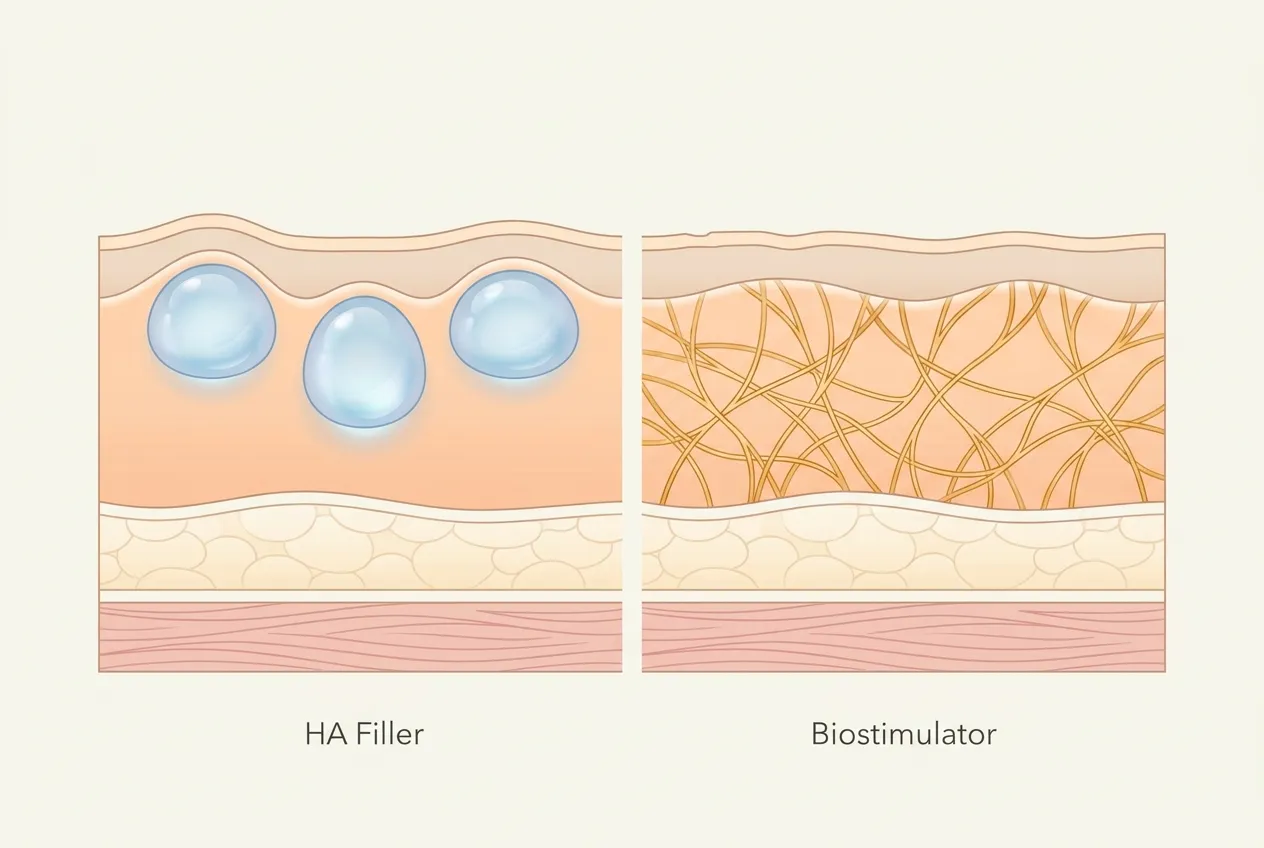
- Hyaluronic acid fillers add volume directly. The gel itself is the volume. Results are immediate, predictable, and reversible with an enzyme called hyaluronidase.
- Biostimulators trigger your own body to make new collagen. The product itself is mostly absorbed; what stays behind is freshly grown collagen scaffolding. Results appear gradually over 2–6 months and last 18–36 months.
- Neither is “better.” They solve different problems and increasingly are used together — HA for instant correction, biostimulator for long-term skin quality.
What Are Biostimulators?
A biostimulator (sometimes called a “collagen stimulator”) is an injectable product whose primary job is not to add volume itself, but to provoke a controlled, low-grade inflammatory response that activates your skin’s fibroblasts. Those fibroblasts then produce fresh Type I collagen — the same structural protein your skin loses by roughly 1% per year after age 25.
The most established biostimulator worldwide is Sculptra (poly-L-lactic acid, or PLLA), originally FDA-approved in 2004 for HIV-associated lipoatrophy and approved for cosmetic facial wrinkle correction in 2009. Other commonly used biostimulators include Radiesse (calcium hydroxylapatite), Sticol (PLLA, popular across Asia), and Ellansé (polycaprolactone).
Their key shared characteristics:
- Mechanism: particles trigger macrophage and fibroblast activity, which deposits new collagen over 8–24 weeks.
- Onset: results begin emerging in week 6–8 and continue improving for 4–6 months.
- Longevity: 18–36 months on average — among the longest-lasting injectables available.
- Look: diffuse, “lit-from-within” skin firmness rather than sculpted volume in a specific spot.
- Reversibility: not reversible — once collagen is built, it must remodel naturally over time.
Because the product is biostimulating rather than space-filling, it is generally injected in deeper tissue planes (subdermal or supraperiosteal) and across broader areas — temples, lateral cheeks, jawline, chest, knees, and even the back of the hands. Patients who do well are typically in their late 30s through 60s with diffuse volume loss and skin thinning rather than a single deep crease.
You can read more about how we use biostimulators clinically on our Biostimulator treatment page.
What Are Hyaluronic Acid (HA) Fillers?
Hyaluronic acid is a naturally occurring sugar molecule found throughout your skin, joints, and connective tissue. It binds up to 1,000 times its own weight in water, which is what makes it so effective for creating immediate volume and hydration when crosslinked into an injectable gel.
The major HA filler families used at our clinic include Juvederm (Allergan), Restylane (Galderma), and Belotero (Merz). Each manufacturer produces multiple gel formulations engineered for specific layers and indications — from soft, flowing gels for the under-eye and lips to dense, lifting gels for the cheekbone and chin.
Their key shared characteristics:
- Mechanism: the gel itself occupies space, displacing tissue upward and outward; mild secondary collagen stimulation occurs through tissue stretch.
- Onset: visible immediately, with 1–2 weeks of integration as swelling settles.
- Longevity: 6–18 months depending on the product and area injected — high-movement areas like lips break down faster.
- Look: targeted, sculpted, contour-defining.
- Reversibility: fully dissolvable with hyaluronidase within minutes if needed — a major safety advantage.
For a complete overview of how we approach HA filler injections, see our Filler & Botox treatment page.
Side-by-Side Comparison
The table below summarises the practical differences patients ask about most often during a consultation:
| Factor | Hyaluronic Acid Fillers | Biostimulators |
|---|---|---|
| Primary action | Adds external volume | Stimulates your own collagen |
| Material | Crosslinked HA gel | PLLA, CaHA, or PCL microparticles |
| Time to visible result | Day 1 | Week 6 to Month 4 |
| Duration | 6–18 months | 18–36 months |
| Sessions to full result | Usually 1 | 2–3 spaced 4–6 weeks apart |
| Reversible? | Yes — hyaluronidase | No — must remodel naturally |
| Best for | Lips, tear trough, defined contour, “filling” a crease | Diffuse volume loss, skin thinning, chest, knees, jawline rejuvenation |
| Look | Sculpted, immediate | Gradual, ultra-natural |
| Typical Bangkok cost (face) | ฿15,000–35,000 per syringe | ฿35,000–60,000 per vial; full course 2–3 vials |
How They Work — The Science Explained
Understanding the underlying biology helps explain why timelines differ so dramatically between the two categories.
The HA Filler Pathway
When a crosslinked HA gel is injected, it occupies space immediately and binds water. Over the next 6–18 months, native enzymes (hyaluronidases) gradually break the crosslinks down and the gel dissolves. A small amount of secondary collagen is laid down where the gel stretched the surrounding tissue, but the dominant effect is mechanical — fill in, fill out, lift up.
The Biostimulator Pathway
When PLLA microparticles are injected into the deep dermis, they sit inert for several days. The body then mounts a controlled foreign-body response: macrophages migrate in, signal fibroblasts, and fibroblasts begin producing new Type I collagen. The PLLA itself slowly hydrolyses into lactic acid and water — by month 18, almost none of the original product remains, but the collagen scaffold it provoked is still there.
A 2025 multicenter randomized controlled trial of 331 patients reported a 90.6% improvement in midfacial volume at 12 months with PLLA, with histologic confirmation of new collagen — one of the strongest data sets currently available for any injectable.

Choosing by Treatment Area
Not every part of the face responds the same way to each category. The right tool depends on tissue thickness, movement, and whether you need contour or quality.
- Lips and perioral lines: HA only. Biostimulators are contraindicated here because of nodule risk in mobile, thin tissue.
- Tear trough (under-eye): HA only — and only with carefully chosen low-G’ gels.
- Mid-cheek and zygomatic arch: Either, or both. HA gives instant lift; biostimulator gives long-term firmness.
- Temples and lateral face: Biostimulator is usually preferred for diffuse hollowing.
- Jawline and chin contour: HA for sharp definition; biostimulator for skin tightening along the mandibular border.
- Neck, décolletage, knees, hands: Biostimulator is the workhorse for crepey, thin skin in these areas.
Combining Biostimulators with HA Fillers
One of the biggest shifts in aesthetic practice over the past five years is the move away from “either/or” toward strategic combination. A typical layered protocol at our clinic might look like:
- Session 1 (foundation): Biostimulator on the deep cheek, temple, and jawline to rebuild structural collagen.
- Session 2 (4–6 weeks later): Second biostimulator session if needed, plus targeted HA filler for specific contour points (chin, nasolabial fold, lips).
- Maintenance: HA top-ups every 9–12 months; biostimulator refresh every 18–24 months.
The combination addresses two distinct aging mechanisms — volume loss and structural thinning — which is why patients in their 40s and beyond tend to look more rested and natural with a layered plan than with HA filler alone.
Side Effects and What to Expect
Both treatments are considered very safe in expert hands, but the side effect profiles differ:
HA Fillers — Common Side Effects
- Mild swelling and bruising for 3–7 days
- Tenderness at injection sites
- Rare: nodules, vascular occlusion (the most serious adverse event — minimised by injector experience and anatomy knowledge)
Biostimulators — Common Side Effects
- Initial post-injection swelling that settles within 24–48 hours
- Bruising in 10–20% of patients
- Rare: late-onset papules or nodules (mitigated by correct dilution, deep placement, and the post-treatment massage protocol)
The most important risk-reduction factor across both categories is the same: an experienced, board-certified dermatologist or plastic surgeon who knows the anatomy and uses authentic, regulator-approved product.
Frequently Asked Questions
Will I look “done” after biostimulators?
No — the gradual onset is one of the main reasons patients choose biostimulators. Friends typically notice that you look “well-rested” or “lifted” without being able to identify what changed.
Can I have both treatments on the same day?
Yes, and many of our patients do. We typically place the biostimulator first in deeper planes, then layer HA filler superficially in specific areas the same session.
If I dislike the result, can it be reversed?
HA filler can be dissolved within hours using hyaluronidase. Biostimulator results cannot be quickly reversed, which is why patient selection and conservative dosing are so important.
How long is the downtime?
Most patients return to work the next day. Visible bruising, if it occurs, can usually be covered with makeup within 48 hours.
Are biostimulators safe long-term?
Sculptra has been on the market since 1999 in Europe and 2004 in the United States, with two decades of safety data. Long-term studies show no increase in cancer risk, autoimmune events, or chronic inflammation when used at recommended doses by trained injectors.
Which is better for someone in their 30s?
For patients in their 30s with mild concerns, low-volume HA filler often delivers the most natural result. Biostimulators become more compelling in the late 30s and beyond, when collagen depletion outpaces what filler alone can correct.
Decision Framework: Which Should You Pick?
Use this short checklist as a starting point for your consultation:
- Pick HA filler if you want a specific contour change, you have an event in 1–2 weeks, you are nervous and want reversibility, or you are treating lips, tear troughs, or perioral lines.
- Pick a biostimulator if your concerns are diffuse skin thinning, crepey texture, generalised volume loss across the face, neck, chest, or knees, and you can wait 2–4 months for full results.
- Pick both if you want long-term skin quality and an immediate visible refresh — the most common recommendation we make for patients aged 40+.
The Dr. Pang Approach
At Dr. Pang Skin Clinic, every injectable consultation begins with skin imaging, a structured facial-aging assessment, and a discussion about your timeline and tolerance for downtime. All injections are performed personally by Dr. Pang, a board-certified dermatologist and certified injection trainer for Allergan, Galderma, and Merz. We use only authentic, regulator-approved product and document every batch number in your patient record.
If you are not sure which treatment is right for your goals, we recommend booking a complimentary consultation rather than self-selecting from a price list — the right answer is usually a tailored plan, not a single product.
References & Further Reading
- U.S. Food & Drug Administration. Sculptra Aesthetic — P030050/S002 Summary of Safety and Effectiveness. Available at: accessdata.fda.gov
- Lin MJ, Dubin DP, Khorasani H. Poly-L-Lactic Acid. StatPearls Publishing; 2023. ncbi.nlm.nih.gov/books/NBK507871
- Cassuto D, et al. Efficacy and Safety of Poly-L-Lactic Acid in Facial Aesthetics: A Systematic Review. Polymers. 2024;16(18):2564. mdpi.com
- Vleggaar D, et al. Collagen Stimulators in Body Applications: A Review Focused on Poly-L-Lactic Acid. Clin Cosmet Investig Dermatol. tandfonline.com
- American Society of Plastic Surgeons. The Rising Popularity of Non-Hyaluronic Acid Fillers: What You Should Know About Biostimulators. plasticsurgery.org
- Cleveland Clinic. Sculptra: What It Is, Where It’s Injected, Results & Risks. my.clevelandclinic.org
This article was prepared by the medical team at Dr. Pang Skin Clinic, Bangkok, and reflects current clinical practice as of 2026. It is intended for educational purposes and does not replace an in-person consultation. Treatment outcomes vary; injectables should only be performed by a licensed, board-certified physician.